











When you step deeper into mechanical keyboards, you’ll quickly encounter more advanced concepts such as polling rate, actuation distance, latency, etc.
Today, we’re taking a closer look at polling rate—what it means, how it works, and whether a higher value always equals better performance.
What is Polling Rate?
Polling rate in mechanical keyboards refers to the frequency at which a keyboard reports its status to the computer, measured in Hertz(Hz). A higher polling rate means faster response to every keystroke and lower latency.
Common polling rate:
125Hz: The keyboard reports its status 125 times per second
1000Hz: The keyboard reports its status 1000 times per second
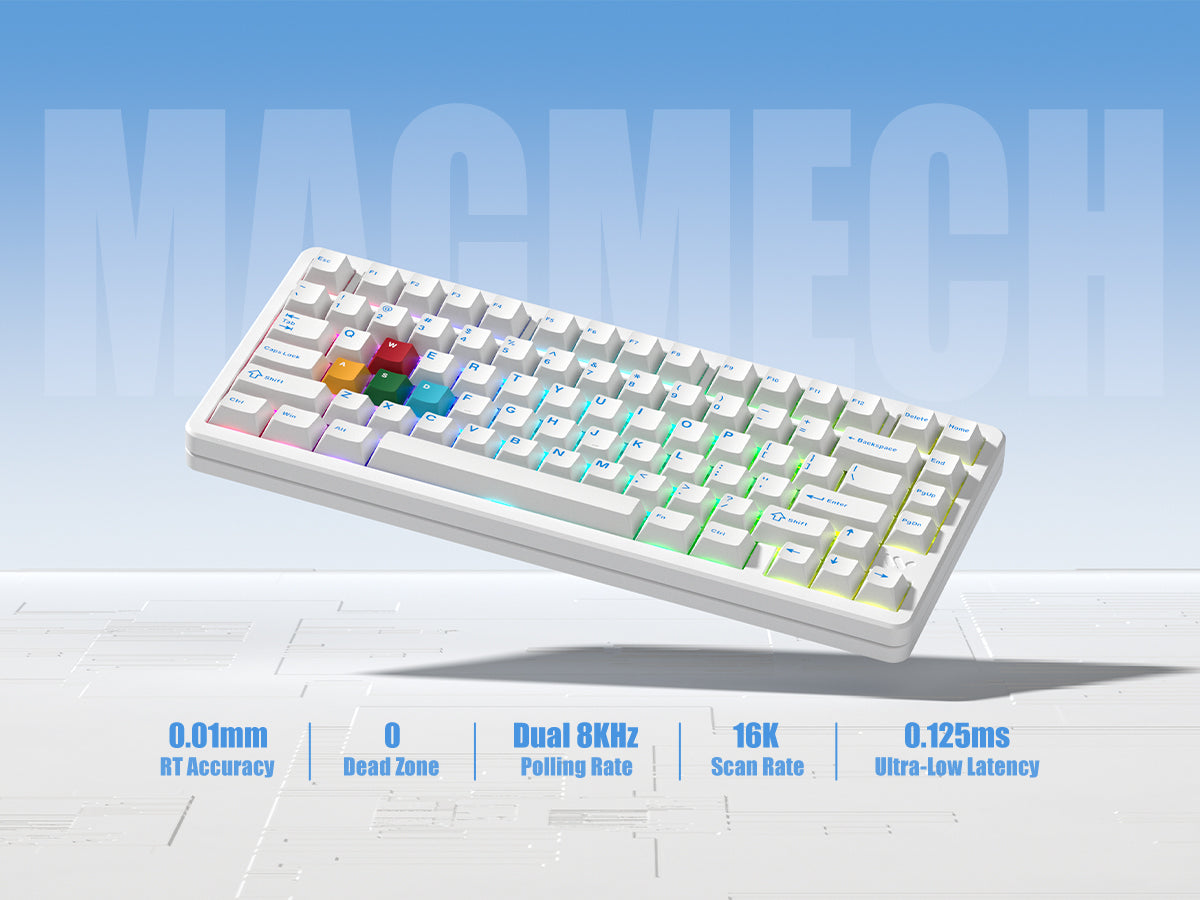
8000Hz: The keyboard reports its status 8000 times per second
|
Polling rate |
Reports time |
Interval (input lag) |
|
125Hz |
125 times per second |
8ms |
|
1000Hz |
1000 times per second |
1ms |
|
8000Hz |
8000 times per second |
0.125ms |
Which Polling Rate Fits Your Use Case?
For average users, web browsing, typing, or even casual gaming, a 125Hz polling rate keyboard is sufficient.
In a more competitive gaming or productivity, a 1000Hz polling rate mechanical keyboard can cover your needs. It offers a noticeable lower latency, better responsiveness to every keystroke, and finds the good balance between performance and consistency.
While for gamers, especially in intense competitive or fast-paced gaming like FPS, fighting games, a higher polling rate keyboard is required.
Does a high polling rate always help?
Does a high polling rate always help? The answer is no.
A high polling rate (eg, 8000Hz) greatly reduces input lag, ensuring that each key press registers quickly and accurately. However, to get real benefits from it, it is affected by other factors:
1. Human Perception
The jump from 1000Hz polling rate to 8000Hz polling rate may seem significantly different numerically—with a report interval difference of 0.875ms—this difference is often hardly perceptible to most people.
And even for some pro players, the improvement is barely noticeable. They pay more attention to the consistency of high performance, rather than the number limits.
2. Operational Accuracy
Fast and accurate responses place higher demands on operational precision. A higher polling rate keyboard reports its status more times per second to interact with the computer, which reacts quicker to your commands. However, if it comes with low-accuracy operations, it can lead to repetitive actions.
Most mechanical keyboards today commonly feature a 1000Hz polling rate. An 8000Hz polling rate is generally found only on HE/TMR magnetic keyboards. As a TMR-based magnetic keyboard, the Womier SK75 TMR stands out with its exceptional polling-rate performance.
Why does SK75 TMR stand out?
The SK75 TMR maintains a full 8000Hz polling rate, both wired and wireless.
Most magnetic keyboards in the market have the same 8000Hz polling rate in wired mode as the SK75 TMR, while their polling rate drops down to 1000Hz in wireless mode.

Final
Most mechanical keyboards today come with a 1000Hz polling rate, which is more than enough for everyday use—whether you’re typing, working, or enjoying casual games.
But for esports players and users who chase every millisecond of performance, magnetic-switch keyboards can unlock a completely different level of responsiveness.
There is no single “best” keyboard, nor does a higher polling rate always guarantee a better experience. The ideal choice will always depend on your needs, habits, and personal preferences—and that’s exactly the beauty of mechanical keyboards.
